| “Organ playing is the manifestation of a will filled with the vision of eternity.” Charles-Marie Widor |
Objectives
By the end of this session, participants will be able to:
- Explain the basic mechanics of the pipe organ and its acoustic properties
- Understand core principles of registration and their impact on choral balance
- Recognize how volume control works on a pipe organ and why it differs from orchestral or piano dynamics
- Make informed decisions about choir placement in relation to pipe location, console location, and sound projection
- Prepare rehearsal scores and communication points for an effective partnership with an organist
- Anticipate and troubleshoot common logistical challenges during organ-choir rehearsals
I. The Organ
- ACTION
- There are two actions (systems of moving parts): KEYS and STOPS
- KEY action causes wind to be admitted into an organ pipe while a key is depressed
- STOP action causes a rank of pipes to be engaged while a stop is pulled out, or “on”
- Actions may be mechanical, pneumatic, or electrical
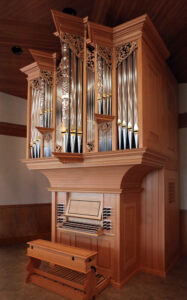
- There are also combinations of these, such as the electro-pneumatic action of the Isabelle B. Harris Organ (Holsclaw Hall, University of Arizona; Tucson, AZ)
- There are two actions (systems of moving parts): KEYS and STOPS
- WIND SUPPLY
- Hand-operated bellows
- Small, fireplace-style bellows pumped by hand. They were used in the earliest organs and provided a basic, often unsteady wind supply.
- Lever-operated wedge bellows
- Larger bellows worked by levers, used from the Middle Ages into the early 1900s. They give a steadier, stronger wind and are still used in historical-style organs.
- Electric blowers
- Modern organs normally use electric blowers to produce a steady, reliable wind with no manual labor.
- Hand-operated bellows
- PIPE VARIETIES
- Flue Pipes
- Sound produced with no moving parts, just the vibration of air (i.e., recorder, whistle)
- Diapasons/Principals, Flutes, Strings
- Reed Pipes
- Sound produced by a beating reed. Wind is directed toward a curved piece of brass. A partial vacuum is created by higher velocity air flowing under the reed which causes it to be pulled closed against a hard surface called the shallot. This shuts off the vacuum and allows the reed to spring open again. A tuned resonator extends above this assembly and reinforces the sound produced.
- Clarinet, Krumhorn
- Trumpet, Oboe
- A rank is a set of organ pipes of the same tonal character that provides one distinct sound across the full range of the keyboard
- Flue Pipes
- THE CONSOLE
- Stops
- Stops are the controls that allow the organist to turn ranks on or off to create different tone colors and dynamic combinations
- The Pitch Level of Stops
- The pitch level of stops indicates how high or low a rank sounds relative to the written keyboard pitch.
- The 8’ stop is “concert pitch,” matching the standard pitch of a piano
- 4’ is one octave higher, 2’ is two octaves higher
- 16’ is one octave lower, 32’ is two octaves lower, 64’ is rare
- CLICK HERE FOR HARRIS ORGAN STOPLIST
- Keyboards
- Manuals
- Pedals
- Divisions of the Organ
- Divisions are the organ’s structural and tonal groupings of pipes. These are noted on each group of stops and manuals.
- English: Great, Swell, Choir, Solo, Orchestral, Echo, Antiphonal
- German: Hauptwerk, Schwellwerk, Rückpositiv, Oberwerk, Brustwerk
- French: Grand-Chœur, Grand-Orgue, Récit, Positif, Bombarde, Solo
- Divisions are the organ’s structural and tonal groupings of pipes. These are noted on each group of stops and manuals.
- Stops
CLICK HERE to see more Tucson Pipe Organs
II. Registrations
- DEFINITION & PURPOSE
- Registration refers to the selection and combination of organ stops to create a desired tonal color, texture, and dynamic level. It shapes how the instrument supports or dialogues with the choir, affecting clarity, warmth, articulation, projection, and the emotional character of the music. Conductors must understand registration to communicate expectations clearly, adjust balance during rehearsal, and collaborate effectively with the organist.
- TONAL GROUPS
- Principals/Diapasons: The main register of flue pipes and the essential “organ” tone, firm and clear, forming the backbone for most choral accompaniments and hymn singing.
- Flutes: Gentle, round and versatile; excellent for supporting quiet choral passages, warm accompaniments, and expressive inner lines.
- Strings: Narrow, shimmering tone that blends subtly with soft choral textures; useful for atmosphere but not typically for strong support.
- Reeds: Colors modeled on orchestral winds (trumpet, oboe, clarinet, bassoon); strong solo voices or bold accents, but must be used sparingly with choirs.
- Mixtures: Bright, sparkling ranks that reinforce upper harmonics; ideal for fortissimo hymn stanzas or when added brilliance is needed, but can easily overpower voices if misused.
- BALANCE & BLEND WITH CHOIR
- Light registrations for polyphonic or transparent textures
- 8′ principals, light flutes, or soft combinations keep clarity while maintaining pitch support
- Chorus registrations for hymns or large-scale works
- Layering principals with 4′ and 2′ ranks, occasionally mixtures, helps produce energy and articulation without overwhelming the choir.
- Solo stops for obbligato or independent lines
- Reeds, solo flutes, or string celestas may carry melodic material while manuals or pedal provide gentle accompaniment.
- Light registrations for polyphonic or transparent textures
Conductors should listen for overbalance in upper harmonics, muddiness in the bass, or stops that clash with vowel spectrum and adjust accordingly.
- REGISTRATION FOR SPECIFIC REPERTOIRE
- Renaissance & Baroque polyphony
- Favor clear 8′ and 4′ principal choruses, with minimal reed use and transparent textures that match historical practice.
- Classical & Romantic oratorio
- Fuller principal foundations, warmer flutes, and selective use of reeds to match orchestral sonorities, with appropriate dynamic shaping.
- 20th–21st Century repertoire
- Flexible combinations depending on harmonic language; may include string celestes, colorful flutes, or even experimental textures.
- Matching tone to national styles
- French Romantic works thrive on warm fonds d’orgue (foundation stops/tone) and expressive reeds
- German Baroque calls for articulate principal choruses
- English cathedral tradition favors broader diapasons and lush foundations
- Antiphonal effects
- When multiple divisions are available (e.g., Swell vs. Great, Choir, or galleries), alternating registrations or echo effects can enhance spatial or dramatic elements.
- Renaissance & Baroque polyphony
III. Volume
- WHY “VOLUME” IS DIFFERENT
- No velocity sensitivity
- volume changes by adding/removing stops or using expression pedals
- Acoustic delay in large spaces, “sound bloom”
- No velocity sensitivity
- FACTORS AFFECTING LOUDNESS
- Number of stops and ranks engaged
- Couplers (linking manuals/pedal divisions)
- Swell shades (enclosed divisions allow crescendo/decrescendo)
- Building acoustics (organ may sound quiet at console, loud in nave)
- COMMUNICATION TIPS
- Use descriptive requests
- “more warmth,” “less brilliance,” “more transparency,” rather than simply “louder” or “softer.”
- Allow for time to adjust registrations during rehearsal
- Use descriptive requests
IV. Choir Placement & Acoustic Considerations
- COMMON PLACEMENT SCENARIOS
- Choir in front of organ case (European cathedral style)
- Choir in chancel with organ chambers to the side.
- Remote console situations
- CHALLENGES
- Delay between conductor’s beat and sound from pipes
- Organ overpowering choir in certain locations
- SOLUTIONS
- Adjusting tempi slightly to account for sound delay
- Using softer or directional registrations
- Physical repositioning of choir if feasible
V. Preparing Before Meeting the Organist
- CONDUCTOR’S PREPARATION
- Mark all organ cues in the score
- Indicate desired registrations or registration types (if known)
- Note fermatas, ritardandos, and tempo changes explicitly
- Have tempi ready (especially for hymn accompaniments)
- MATERIALS FOR ORGANIST
- Provide a clean, well-marked score well in advance
- Include rehearsal letters/numbers
- Share a repertoire list and stylistic expectations early
- FIRST MEETING CHECKLIST
- Walk through pieces once to check registration and tempI
- Discuss difficult page turns or manual changes
- Identify any moments requiring special coordination
- e.g., choral-organ interludes
VI. Common Pitfalls & How to Avoid Them
- Not allowing enough time for organist to set pistons
- Ignoring building acoustics during planning
- Expecting piano-style responsiveness from organ
- Overusing the full organ sound for every piece
Scores Referenced
O come, all ye faithful (arr. David Willcocks)
Recommended Reading